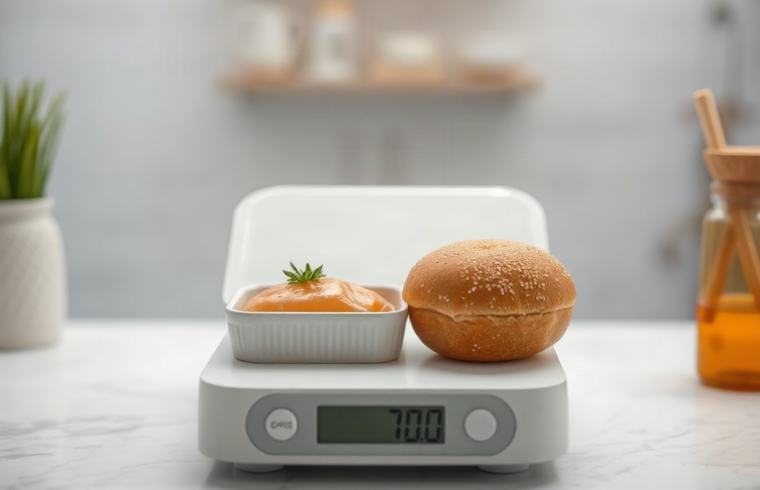
Food scale use improves the accuracy of weight loss portions by measuring food in grams, separating edible food from containers, and reducing errors caused by visual estimates. Place an empty bowl on the scale, press tare, add each ingredient separately, and record the weight that matches the correct nutrition entry. Weigh calorie-dense foods such as oils, cheese, cereal, nuts, and spreads most consistently because small serving differences can add substantial energy. Compare foods in the same state listed in your tracker—raw, cooked, drained, or frozen—and use weighing as a temporary calibration tool rather than a reason to pursue perfect measurements.
Why Does a Food Scale Improve Portion Accuracy?
A kitchen scale exposes differences that measuring cups, package labels, and visual judgment often conceal. A loosely filled cup of cereal may contain less than a packed cup, while a spoonful of peanut butter can vary considerably depending on how it is scooped. Weight in grams avoids those shape and packing differences, giving the food log a more consistent basis.
That consistency matters most when the food is energy-dense. An extra handful of nuts, a heavy pour of dressing, or more oil left in the pan may look minor but can change a meal’s estimated energy content more than an imprecisely measured serving of leafy vegetables. A scale does not cause weight loss by itself; it improves the information used to judge whether portions align with a chosen eating plan.
Visual estimation is still useful, especially when eating away from home. The mistake is assuming that familiar-looking portions are automatically accurate. Bowls, glasses, plates, and packaged pieces differ in size, and repeated underestimation can make a recorded intake look lower than the food actually consumed. Weighing meals at home for a few weeks can train the eye by showing what 30 grams of cheese, 150 grams of cooked rice, or 200 grams of yogurt looks like in the dishes used most often.
Scale readings also have limits. Nutrition labels and food databases describe representative values rather than the exact composition of every piece of food. Restaurant recipes, water loss during cooking, leftovers, and unrecorded tastes can introduce additional uncertainty. Treat gram weights as a way to reduce avoidable error, not as laboratory-level proof of energy intake.
A useful sign that weighing is working is improved consistency: repeated breakfasts produce similar weights, recipe portions divide predictably, and the food record reflects what was actually served. If measurements are precise but entries are selected inconsistently, condiments are omitted, or cooked food is logged as raw, the scale is providing detail without true accuracy.
How Do You Weigh Food Correctly?
Correct weighing begins with a stable, level surface and the tare function. Turn on the scale, choose grams, place the empty plate or bowl on top, and press tare so the display returns to zero. Add the food and record only its weight. Grams are generally easier to match with labels and nutrition databases than ounces, particularly for small servings.
Multiple ingredients can be measured in one bowl without dirtying extra dishes. After adding and recording the first ingredient, press tare again before adding the next. For oatmeal, for example, weigh the dry oats, tare, add milk, tare again, and then add fruit or nut butter. Each number corresponds to a separate database entry even though the meal stays in one container.
The reverse-weighing method is often faster for spreads, oils, and foods taken directly from a jar. Put the full container on the scale, tare it, remove the amount being used, and read the negative number. If the display shows minus 18 grams after peanut butter is spread on toast, 18 grams left the jar. This avoids trying to scrape a sticky ingredient from a measuring spoon while accounting for what remains on the utensil.
| Task | Recommended Scale Action | Common Error |
|---|---|---|
| Weigh food in a bowl | Tare the empty bowl first | Recording food plus container weight |
| Add several ingredients | Record each one, then tare again | Logging the combined weight as one food |
| Measure oil or a spread | Use reverse weighing from the container | Estimating a pour or rounded spoon |
| Divide a prepared recipe | Weigh the finished edible batch | Assuming each ladle contains an equal share |
Check the scale’s unit before every session. Confusing ounces with grams or fluid ounces with weight can produce a large logging error. A food scale measures mass, not volume, so a milliliter conversion should not be assumed for every liquid. Water is straightforward, but oils, syrups, and other liquids have different densities. Use the label’s gram value when it is provided.
Routine checks are more useful than obsessive recalibration. Confirm that the display returns to zero, replace a weak battery if readings drift, and test a familiar packaged item if the scale behaves unexpectedly. Do not weigh hot cookware unless the scale is designed to tolerate it; transfer food to a safe container or let the pan cool first.
How Should Raw, Cooked, and Packaged Foods Be Recorded?
The measured state of a food must match the state described by its nutrition entry. Cooking changes weight mainly through water gain or loss, even when the food’s underlying energy has not changed by the same proportion. Dry rice absorbs water and becomes heavier, while meat commonly loses water during cooking and becomes lighter. Logging 150 grams of cooked rice against an entry for 150 grams of dry rice would therefore create a major mismatch.
Choose either a raw or cooked method and apply it consistently. Raw weights are convenient during meal preparation because ingredients can be measured before they enter the pot or pan. Cooked weights work well for leftovers and batch-prepared food, provided the selected entry clearly identifies the cooking method. Grilled, boiled, roasted, and drained versions may not be interchangeable because added fat and retained water can differ.
For a mixed recipe, record the amounts of all ingredients first and then weigh the finished edible batch. Exclude the pot by taring it before filling or by subtracting its known empty weight. If a prepared chili weighs 1,800 grams and the serving placed in a bowl weighs 450 grams, that bowl represents one-quarter of the recorded recipe. This method is more reliable than assuming four ladles are equal, especially when solids settle or portions are served on different days.
Packaged foods require a label check rather than blind trust in the stated piece count. A label may describe a serving as both a number of pieces and a gram weight. Individual slices, crackers, tortillas, and baked products can vary, so the gram amount is the more direct comparison when accuracy matters. For canned beans, tuna, or fruit, determine whether the label and tracker entry refer to drained or undrained contents.
Database choice can undermine otherwise careful weighing. Prefer entries with a clear food description, preparation state, and gram-based serving. USDA FoodData Central can help verify basic foods, while the package label is usually the most relevant source for a specific branded product. A suspicious entry—such as cooked pasta with values resembling dry pasta—should be replaced rather than adjusted by guesswork.
Which Foods Are Most Worth Weighing?
Prioritize foods for which a small difference in weight meaningfully changes the meal. Cooking oils, butter, nut and seed spreads, cheese, nuts, granola, cereal, rice, pasta, dried fruit, sauces, and snack foods are strong candidates. Their portions are easy to underestimate, and some are difficult to measure consistently with spoons or cups.
Protein foods are also worth checking while learning portions. Chicken, fish, tofu, ground meat, yogurt, and beans may be central to meal planning, but the logged entry must reflect whether the weight includes bones, skin, liquid, or other inedible material. Weigh the edible portion whenever possible. A bone-in chicken piece should not be treated as though every gram will be eaten.
Support Your Weight Loss Goals Huge Discount on the Best Certified Organic Nutrient Dense Supplement!
Low-energy vegetables and whole fruit usually require less precision unless a structured plan calls for exact tracking. Weighing a banana without its peel can refine a log, but spending several minutes measuring lettuce, cucumber, and herbs may add little decision value. The oils, dressings, cheese, croutons, and seeds added to the salad are more likely to explain a meaningful discrepancy.
A practical priority order keeps the process manageable:
- Measure added fats and spreads first. Pours and rounded spoonfuls are difficult to judge.
- Check dry grains, cereal, and snacks. Container size and packing distort visual estimates.
- Weigh recipe ingredients and the final yield. This produces more defensible serving calculations.
- Calibrate frequently eaten proteins and dairy foods. Repetition makes visual estimation easier later.
- Use judgment for produce and very low-energy additions. Precision should serve a practical purpose.
Restaurant meals remain estimates even if leftovers are weighed at home. Unknown oil, sauces, ingredient ratios, and cooking losses cannot be reconstructed from the final weight alone. A scale is best suited to foods prepared or portioned where the ingredients are known. For meals outside the home, a reasonable database estimate is often more honest than assigning false precision to the plate’s total weight.
How Can You Use a Scale Without Overtracking?
A food scale works best as a calibration and consistency tool, not as a demand for perfect control. Begin with the meals and ingredients that recur most often. Measuring a regular breakfast, the oil used at dinner, and common snacks may reveal more than weighing every vegetable, garnish, or splash of a negligible ingredient.
A two-stage approach is practical. During the calibration stage, weigh priority foods consistently for two to four weeks and compare the results with previous visual estimates. During the maintenance stage, continue measuring items that remain difficult to judge while estimating familiar, repeatable portions. Recheck occasionally when changing bowls, brands, recipes, or serving utensils.
Progress should be assessed from patterns rather than a single scale reading or food log. Body weight naturally fluctuates with hydration, food in the digestive tract, sodium intake, and other factors. If portions are being recorded consistently but the expected trend does not appear over several weeks, review missed drinks, oils, condiments, weekend meals, database mismatches, and recipe calculations before reducing portions automatically. A qualified dietitian can help when intake needs are medically complex or when tracking creates confusion.
Rigid weighing can become counterproductive if eating away from home causes distress, minor gram differences dominate attention, or meals cannot be eaten until every component is recorded. In that situation, reduce the scope of tracking or pause it and seek appropriate professional support. People with a history of disordered eating may need individualized guidance before using detailed food measurement.
The best long-term system is the least intensive method that still produces useful feedback. Some people continue weighing oils and recipe batches while estimating produce and familiar proteins. Others use the scale only when a package changes or progress becomes difficult to interpret. Success is not measured by how often the scale is used; it is reflected in whether portions are understandable, records are reasonably consistent, and the process remains compatible with ordinary meals.
Conclusion
Useful portion measurement depends more on consistency than on chasing perfect precision. Tare the container, use grams, match each weight to the food’s raw, cooked, drained, or packaged state, and concentrate first on calorie-dense ingredients that are easy to underestimate. Mixed dishes become easier to record when every ingredient and the final cooked yield are weighed.
Start by measuring recurring meals and uncertain portions for a few weeks. Keep the practices that reveal meaningful differences, and relax measurements that add effort without changing decisions. If results remain difficult to interpret, audit database entries, cooking states, oils, drinks, condiments, and recipe servings before assuming the food scale has failed. The goal is a dependable picture of normal intake that can eventually require less measuring, not a permanently exact record of every gram.
Frequently Asked Questions
Should food be weighed before or after cooking?
Either method can work, but the weight must match a nutrition entry for the same state. Record raw food with a raw entry and cooked food with an entry that identifies the cooking method.
Is weighing food more accurate than using measuring cups?
Usually, especially for solids and foods that pack unevenly. Gram weights are less affected by air gaps, compression, ingredient shape, and differences in how a cup is filled.
Do spices and low-calorie vegetables need to be weighed?
Not usually for routine weight management. Prioritize oils, spreads, cheese, grains, snacks, sauces, and other foods where a modest portion error has greater impact.
How do you weigh food without including the plate?
Place the empty plate on the scale and press tare before adding food. The display should return to zero, allowing it to show only the food’s weight.
Should every meal be weighed indefinitely?
No. Many people use a scale intensively for a short calibration period, then continue with foods that are difficult to estimate and recheck familiar portions occasionally.